
Entre Latinas
Categories:
Role: Design Lead and Researcher
Timeline: 2 months
Scope: Research, responsive UX/UI, prototyping, service ecosystem thinking
Methods: Interviews, field observation, content analysis
Tools: Figma, Adobe Illustrator, Photoshop, InDesign
Additional Credits:
Advising and critique support by Gaby Hernandez
Thanks to Lia Uribe and Irma Chávez for sharing their information for the interviews. Their insights added so much value to the research!.
Year: 2023
Context:
I led Entre Latinas as:
• Design Lead and Researcher,
• UX/UI designer
I conducted interviews, observation, and content analysis, then translated those insights into a responsive platform concept.
While the project was independently led, it was shaped by collaboration with community leaders Lia Uribe and Irma Chávez, as well as advisor feedback that helped strengthen the final mentorship model and overall system.
Entre Latinas is a responsive digital platform concept for Latina leaders and entrepreneurs in Northwest Arkansas. I led the research, UX/UI design, and prototyping of a bilingual learning and mentorship experience that combines events, self-paced education, and one-on-one support into a scalable community-centered system
Full Research here
Let’s Start with the WHY?
Northwest Arkansas is changing. Fast. The Hispanic and Latino population grew to over 17% of the region by 2021, forecasted to reach 19% by 2026. More Latinas are graduating from college. More are opening businesses. More are stepping into leadership.
But the systems supporting that growth weren't keeping up. This is a story about access 😱.
Entrepreneurship resources already existed in Northwest Arkansas, but they were not designed for the women who needed them most. Research showed that many available materials were written entirely in English, used dense academic language, relied on imagery that did not represent the local community, and were distributed through channels Latina entrepreneurs were not using.
The resources existed. The people were ready. But the bridge between them was broken.
This meant the challenge was not simply to add more information. The real design problem was to transform existing support into an experience that felt understandable, culturally relevant, trustworthy, and actionable. In other words, this was not just a language issue. It was an information architecture and communication design problem.
-
How do Latina women leaders in Northwest Arkansas contribute to innovation and the local economy?
How can design better support their efforts to foster inclusivity within their communities?
This theorical problem researches the roles and contributions of Latin American women leaders in terms of economic growth and innovation within their communities. It also explores how design, as a tool or strategy, can assist in advancing inclusivity within these communities. In essence, it’s a question that seeks to understand the impact of these women leaders and how design can be used to enhance inclusivity in the areas they influence.
-
I used interviews, observation, and content analysis to understand how Latina entrepreneurs in Northwest Arkansas access business support and where existing systems were falling short. This helped me move beyond assumptions and understand the problem from multiple perspectives: lived experience, real support interactions, and the design of the resources themselves. Across all three methods, I found that the barrier was not simply whether resources existed, but whether they felt understandable, relevant, and trustworthy enough to use.
Key insights
Access was more than translation.
Trust had to come before commitment.
Support needed to feel relational, not transactional.
Generic resources reduced relevance.
Community was part of the product value.
-
Bilingual by default
Irma Chávez said it directly: if the information isn't in Spanish, people won't engage.Mobile first
The community is primarily on their phones. Designing for mobile wasn't a technical preference; it was a user reality.Mentorship as a core feature
With my advisor suggestion, the mentor fea transformedture the platform from a top-down resource into a self-sustaining community. People trust people who have walked the same path.What I designed:
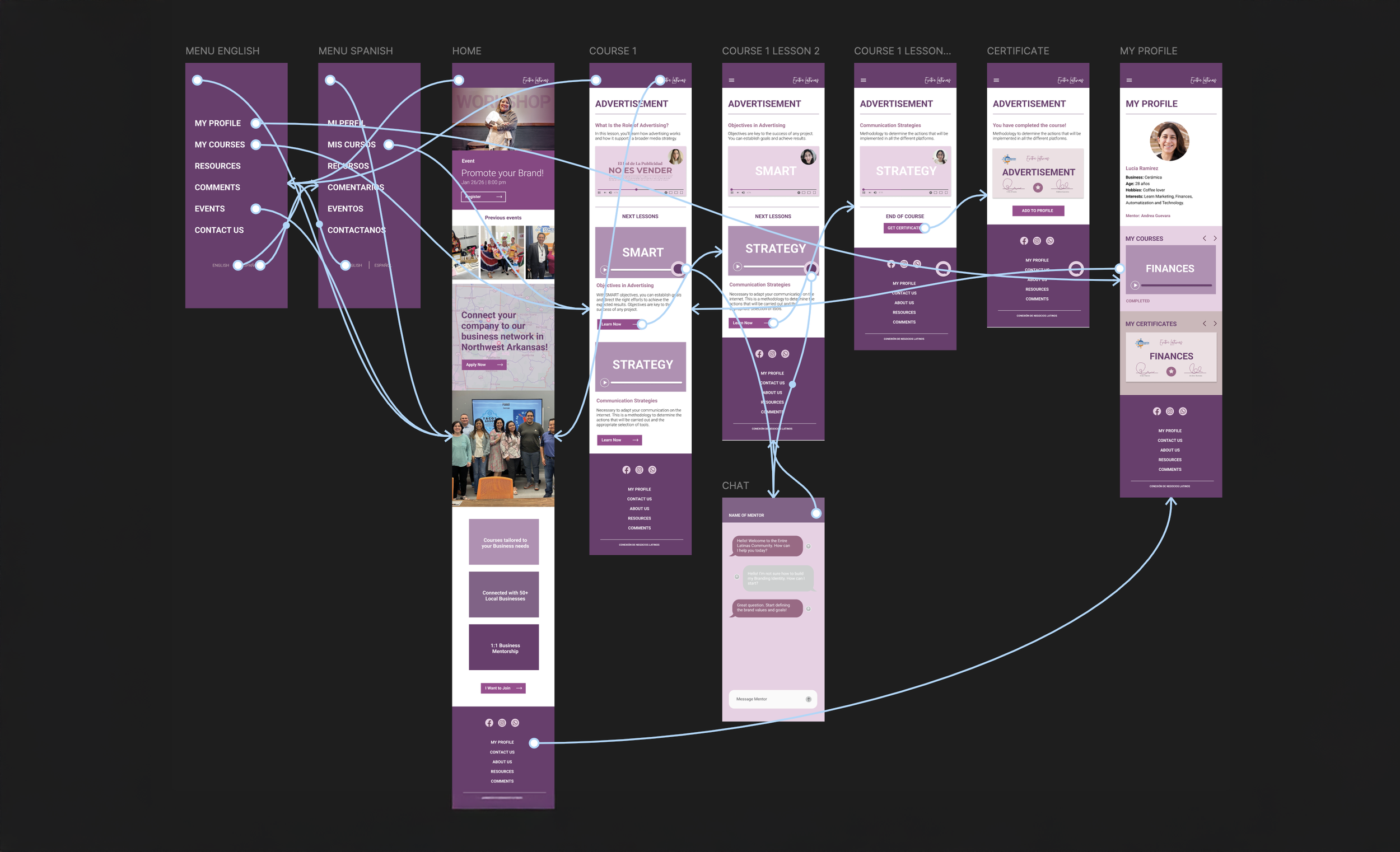
Information architecture, user flows, wireframes, and a high-fidelity prototype for mobile and desktop, within a two-month timeline.
Accessibility considerations included:High-contrast typography
Clear iconography
Simple interface patterns
Bilingual platform
Three product decisions shaped the final direction.
1. Community first, not promotion first
2. Personalized learning instead of one-size-fits-all content.
3. Mentorship as part of the product, not an added feature.

🌱 Desire
Latin American women want to grow businesses that support their families and build long-term stability in their communities. They are looking for practical knowledge in a language they understand, from people who have walked the same path.
🔥 Frustration
The resources exist. But they are written in English, designed for a general audience, and built on assumptions that don't reflect this community. During COVID-19, many Latina entrepreneurs didn't apply for free government relief money, not because they weren't eligible, but because the system felt like a trap. That is what inaccessible design costs in real life.
💖 Motivation
Seeing other Latinas succeed is the strongest driver of continued engagement. Trust, shared experience, and community are not soft features. They are the reason women showed up and want to connect with other Latinas. Over 100 women attended the first Entre Latinas community event. Irma Chávez started Conectando Entre Latinas on March 8th with a kickoff event. More than 41 women arrived. By the next event, that number grew to over 100. That only happened ‘cause of a feeling of belonging, not from marketing.
Who was I designing for?
Latin American women leaders in Northwest Arkansas who were entrepreneurs or leaders in the area.
The research didn't follow a straight line. It started with a plan and stayed flexible. That flexibility is exactly where the most important insights came from.
Method 1: In-depth interviews
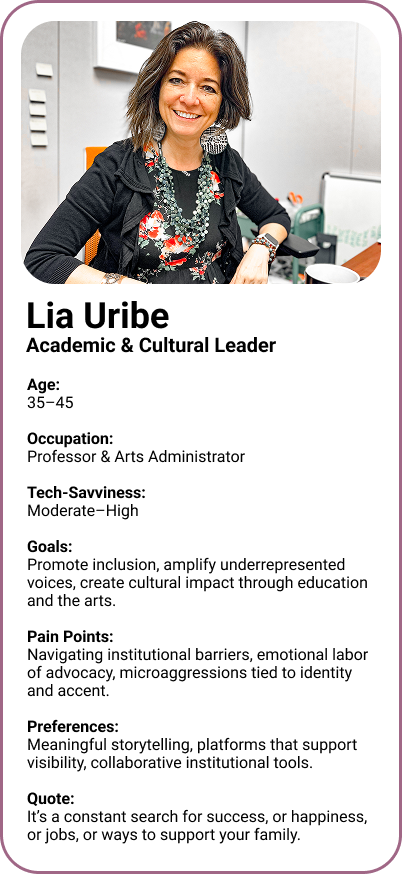
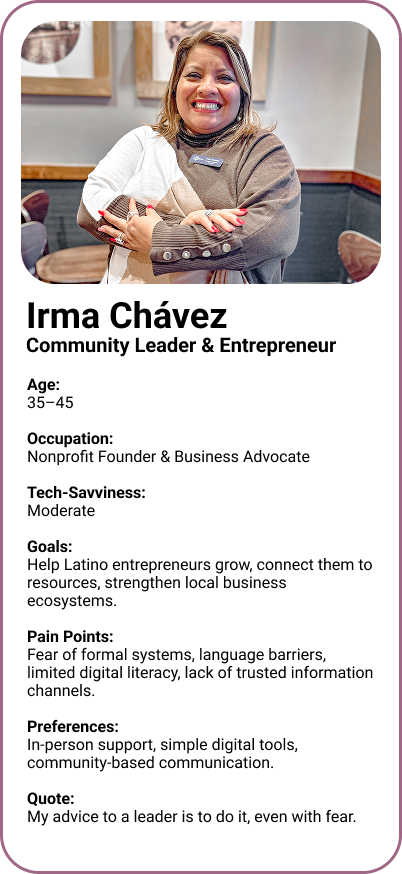
I chose interviews because stories reveal what surveys can't. Interviews provide insights from lived experiences. Sitting across from Lia Uribe and Irma Chávez, I wasn't just collecting data; I was connecting with these leaders. I was able to listen to two women describe entire systems through the lens of their own survival and leadership.
Lia Uribe, Associate Dean at the University of Arkansas, described being seen as an accomplished professional inside the university and walking into her local Walmart the same day and being treated simply as “the immigrant” with a strong accent. The same woman. Two completely different experiences based on context.
Irma Chávez built Conexión de Negocios Latinos from the ground up, starting with nothing but trust and persistence. She described how Latino entrepreneurs didn't apply for COVID relief funds, not because they weren't eligible, but because they were afraid. Afraid the government would use it to find them. That fear was the system failing them, not the other way around.
These weren't just emotional stories. They were design briefs. Where representation brings visibility and trust!. With this information, I was able to build user personas.
Method 2:
Fly on the wall at Conexión de Negocios Latinos
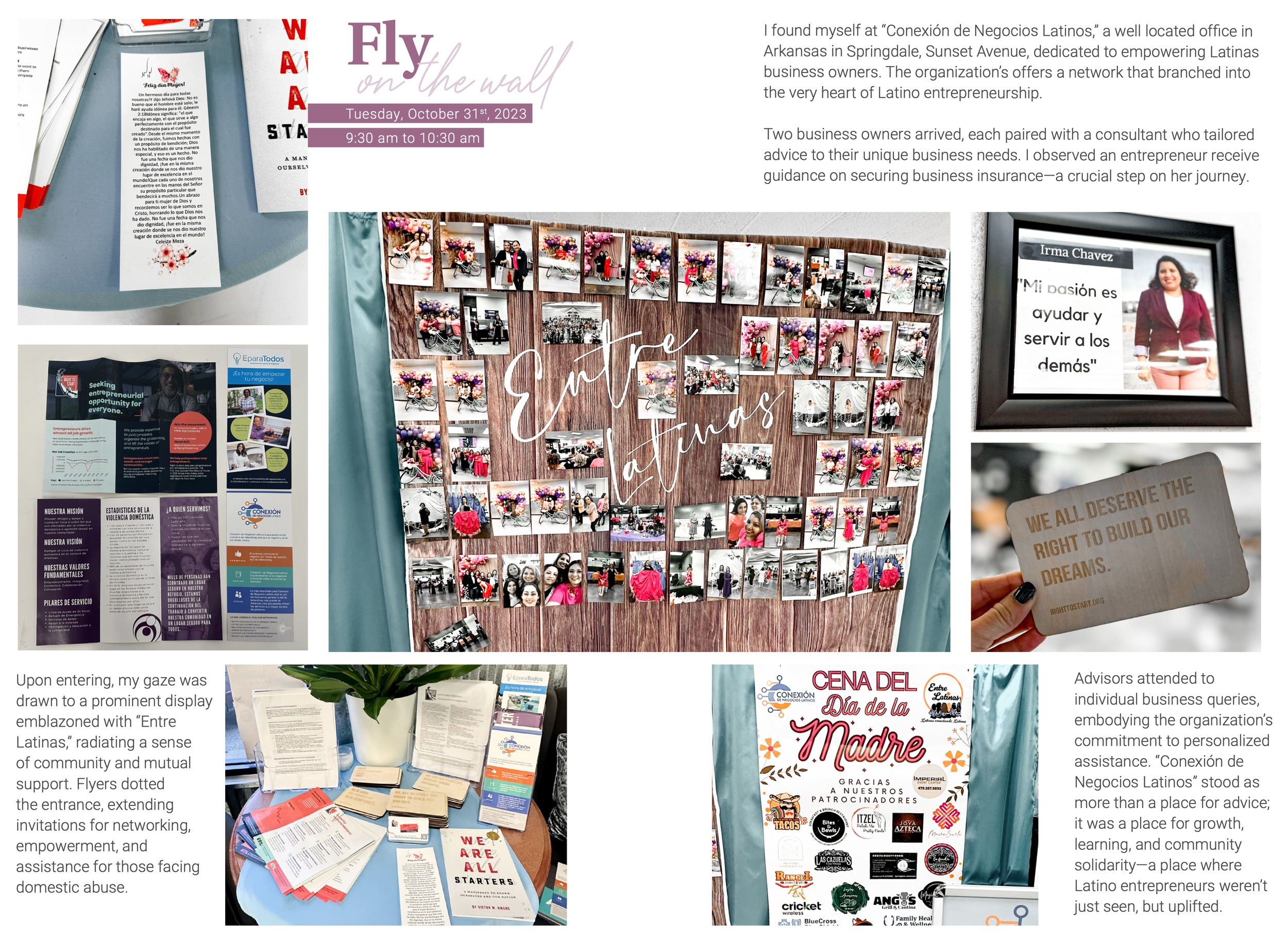
I wanted to observe without interfering. How does support actually work in practice? What does a real consultation between an entrepreneur and an advisor look like?
What I saw confirmed what the interviews suggested. The support was deeply personal, one-on-one, built on relationship and trust. The organization wasn't just providing information. It was providing safety. That insight directly shaped the mentorship model in the platform.
Method 3:
Content analysis of existing University of Arkansas materials
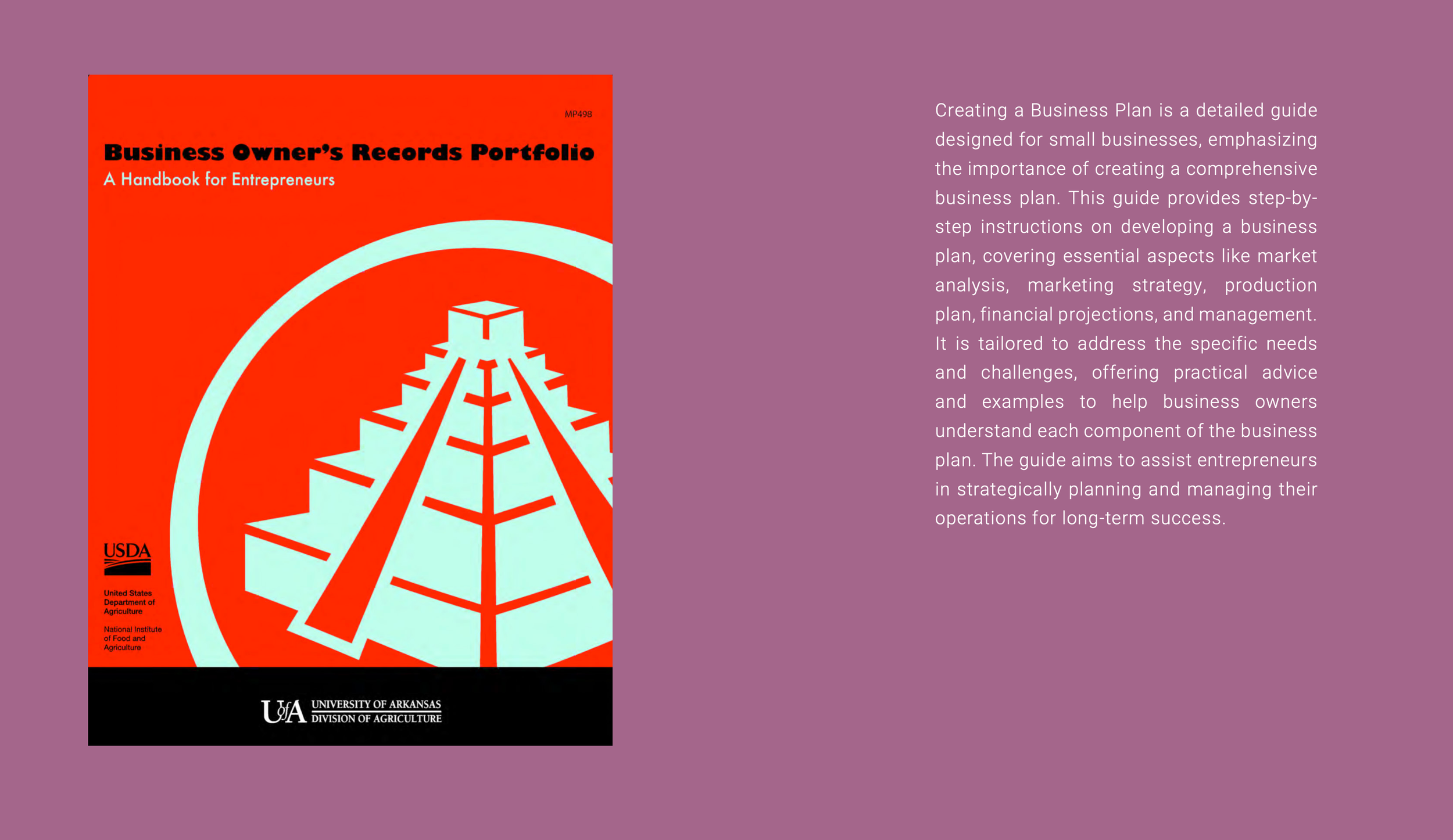
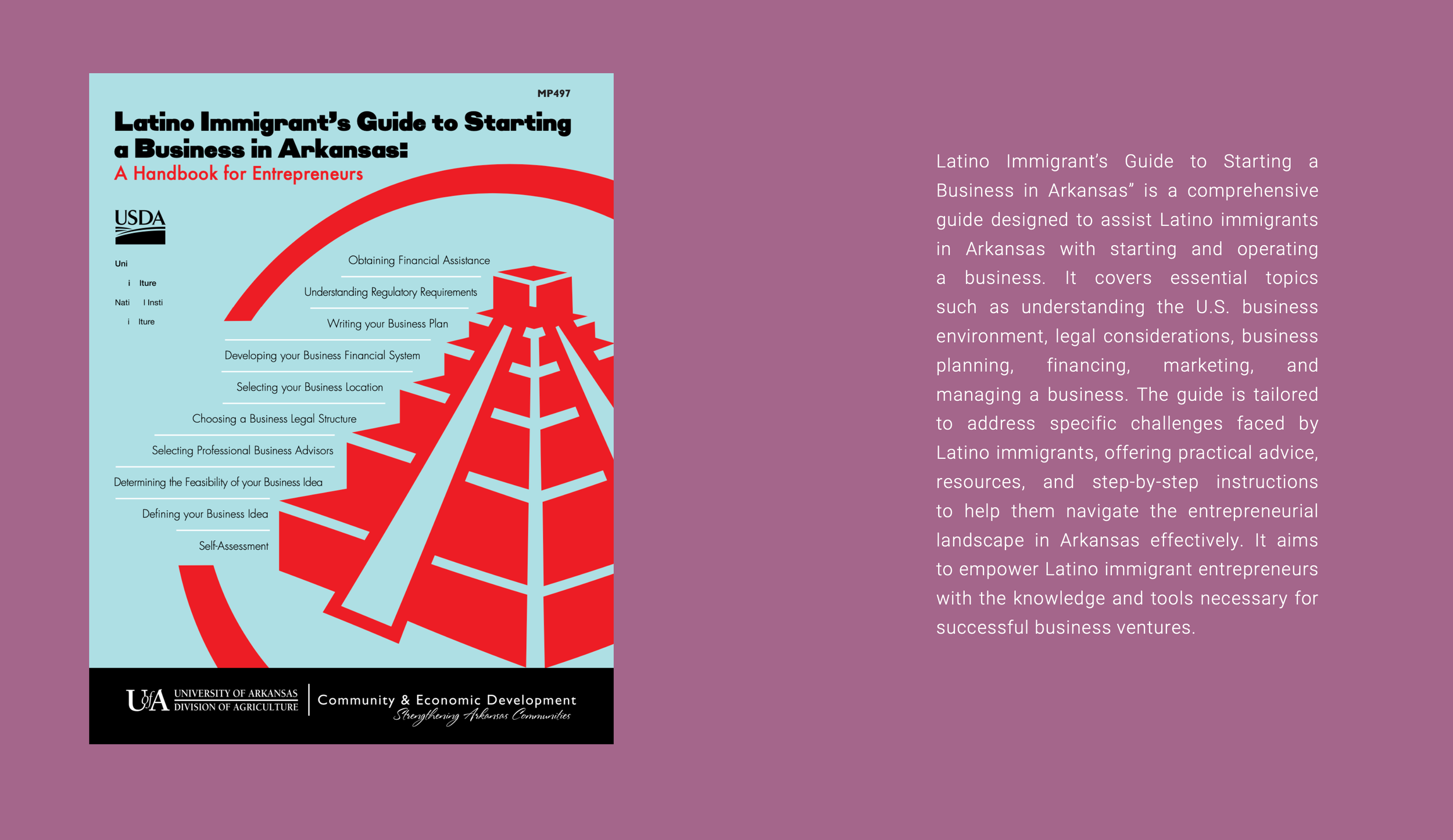
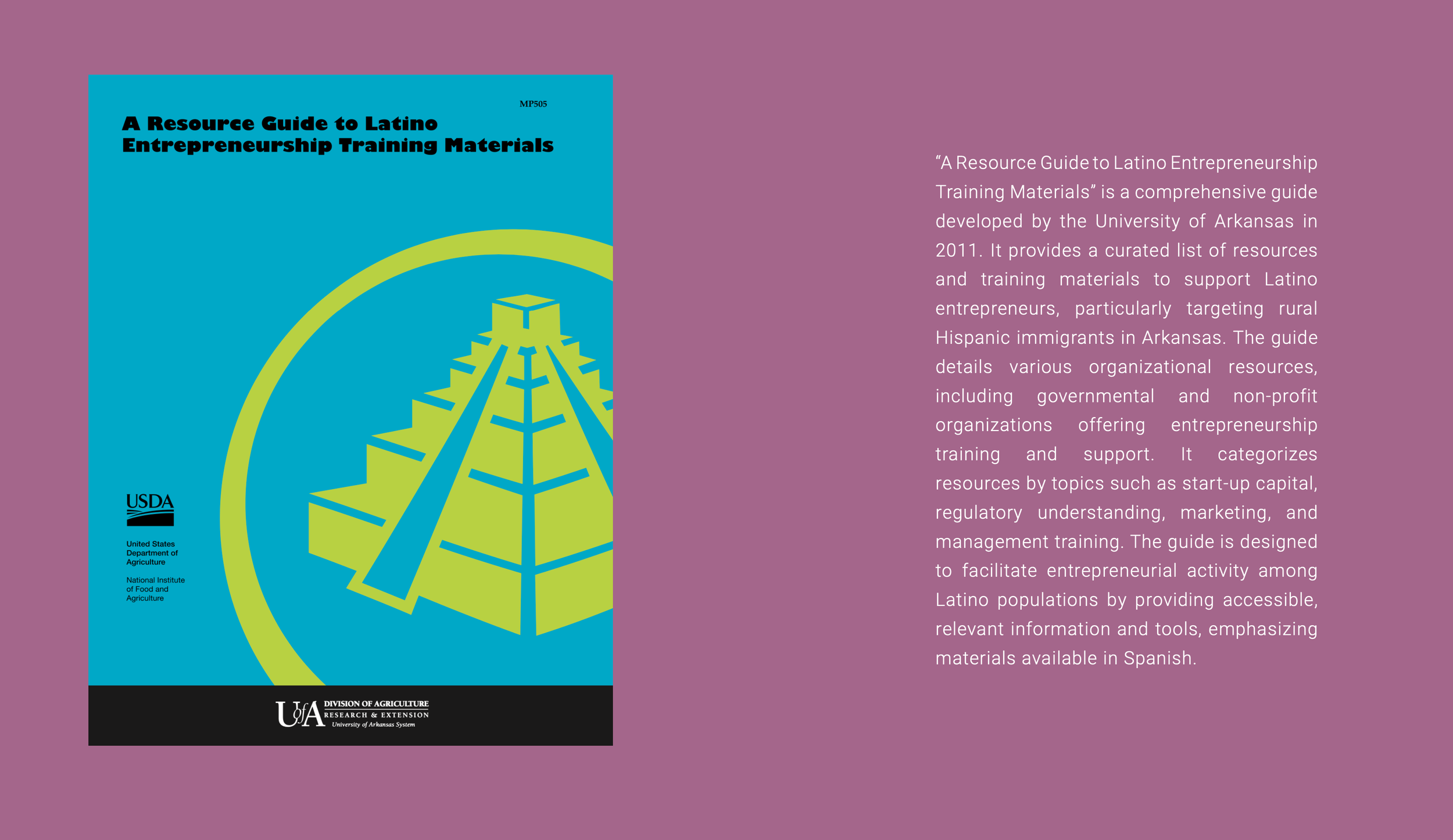
Before designing something new, I needed to understand what already existed. The University of Arkansas has been offering entrepreneurship resources for Latino communities since 2010. On paper, the tools were there.
But when I looked closely, the gap became impossible to ignore. The guides were written entirely in English. The language was academic and dense, difficult to follow even for fluent English speakers. And the imagery on the covers featured biased illustrations.
The message, unintentional as it was, was clear. These resources were not made for the user in mind.
How my thinking evolved
I came into this research with a dangerous assumption: I'm Latina, I get this community. What I encountered instead were stories of survival, fear, and pain that went far beyond anything I anticipated. These women weren't just navigating business challenges. They were navigating entire systems that weren’t built with the user in mind.
That realization changed the design question entirely. It stopped being about adding more resources and became about designing resources that actually work for the people who need them most.

Define & Ideate
🌿 Community-Centered Digital Platform
Design can support future generations of Latin American entrepreneurs by fostering community-centered digital spaces that encourage learning, confidence, and long-term growth. By positioning community at the core of the experience, the platform creates a welcoming entry point for entrepreneurs who may feel excluded from traditional business support systems.
📚 Accessible Learning & Business Resources
Research revealed that many participants were unaware of existing institutional business resources, including materials offered by the University of Arkansas, highlighting a significant accessibility and communication gap. The proposed Entre Latinas platform addresses this by providing structured, easy-to-navigate learning programs, bilingual content, and practical business tools in one centralized space.
🤝 Mentorship as a Sustainable Growth Model
Beyond education, long-term success depends on continued guidance and encouragement. Entre Latinas integrates graduated mentorship, allowing entrepreneurs who complete the program to transition into mentor roles for new participants. A peer-to-peer leadership model creates a sustainable knowledge-sharing cycle that uplifts the next generation of entrepreneurs.
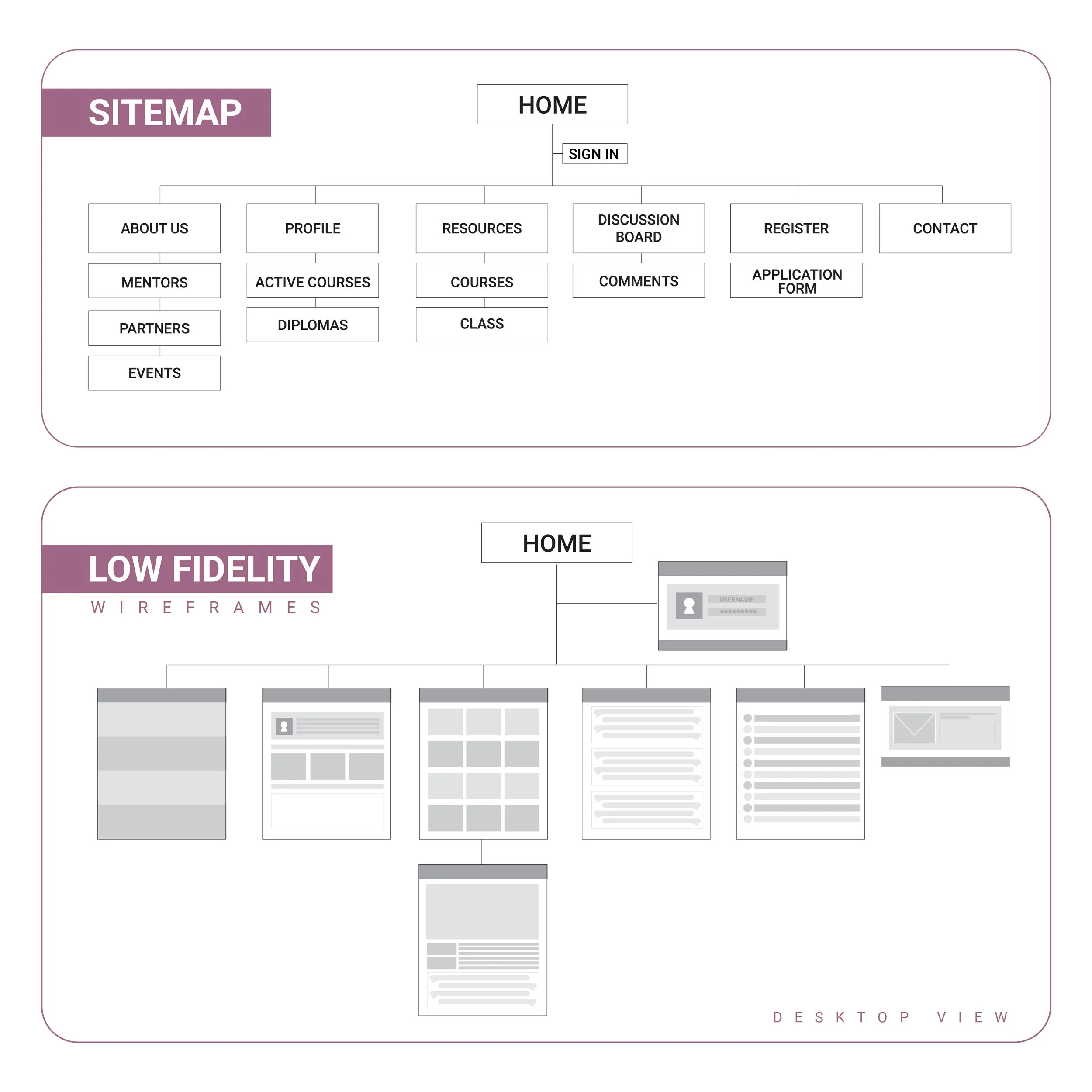
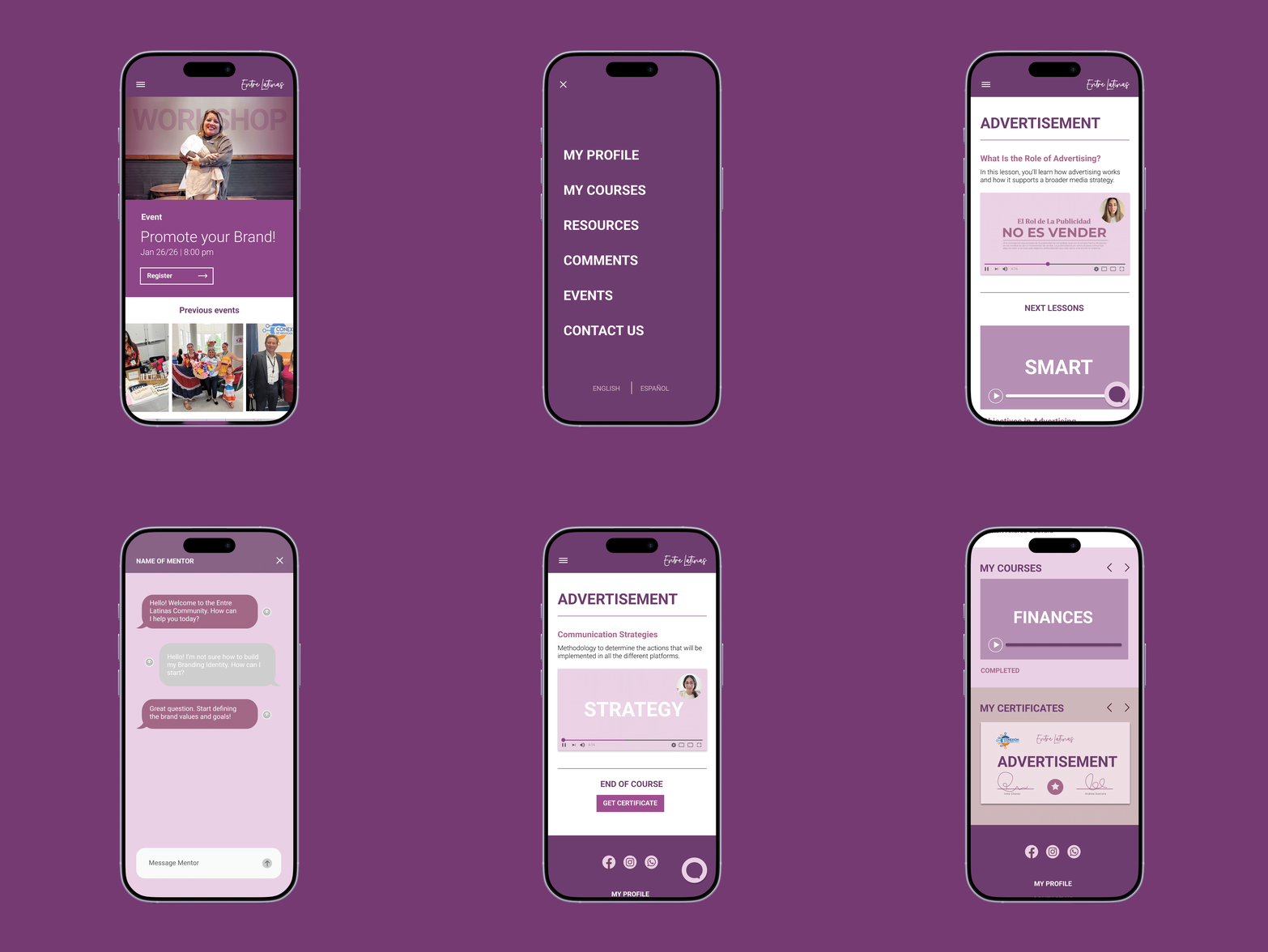
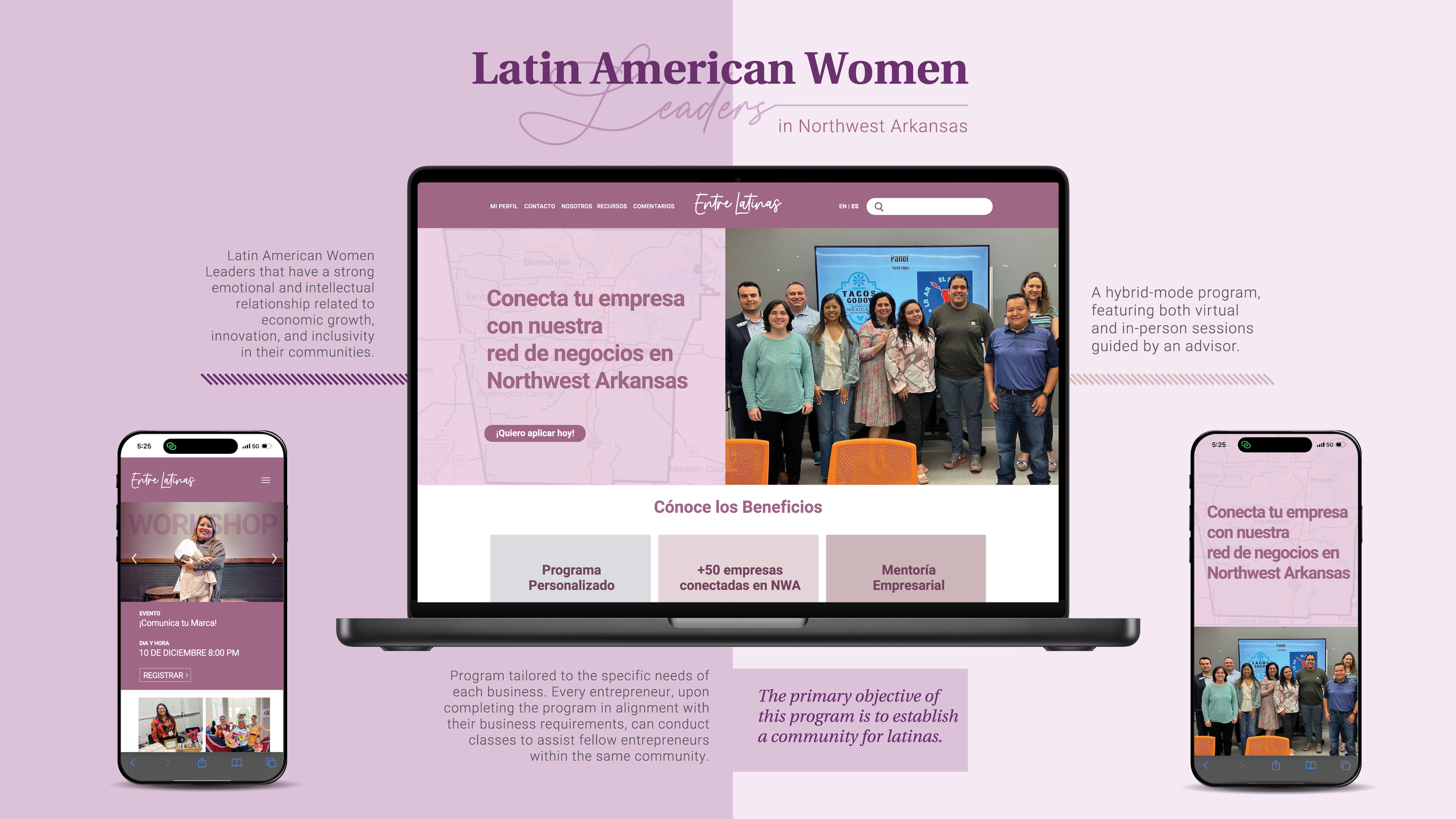
The home page: Events first!
Most platforms lead with a sales pitch. Entre Latinas leads with events. That was a deliberate research-driven decision. Irma Chávez described how the Latino community doesn't trust institutions immediately. Trust is built in person, through shared experience and showing up. The home page reflects that reality. Before asking anyone to enroll in a course or commit to a program, the platform invites them to simply come to an event. Low barrier. High connection.
The learning journey: personalized from the start
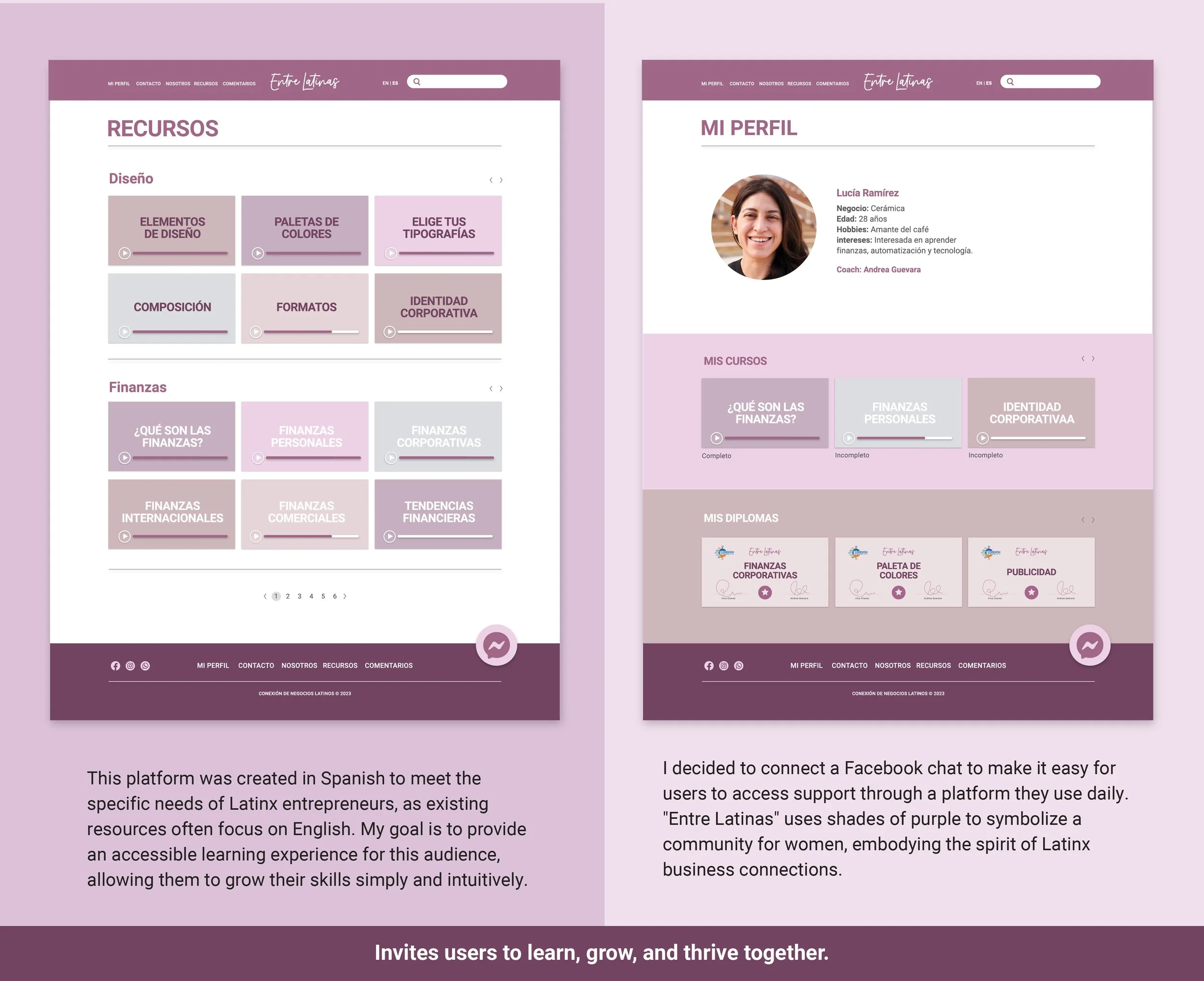
The platform is not a generic course catalog. The idea behind Entre Latinas is that when an entrepreneur connects with Conexión de Negocios Latinos, they receive a diagnosis of their business needs. Based on that conversation, they get assigned specific courses across three areas: marketing, finance, and design. They can also explore additional videos beyond their assigned path if they want to go deeper.
This personalization matters because one of the clearest insights from the research was that generic information feels irrelevant. A woman running a restaurant has different needs than a woman selling handmade goods. The platform respects that difference.
The course experience: learning that fits real life
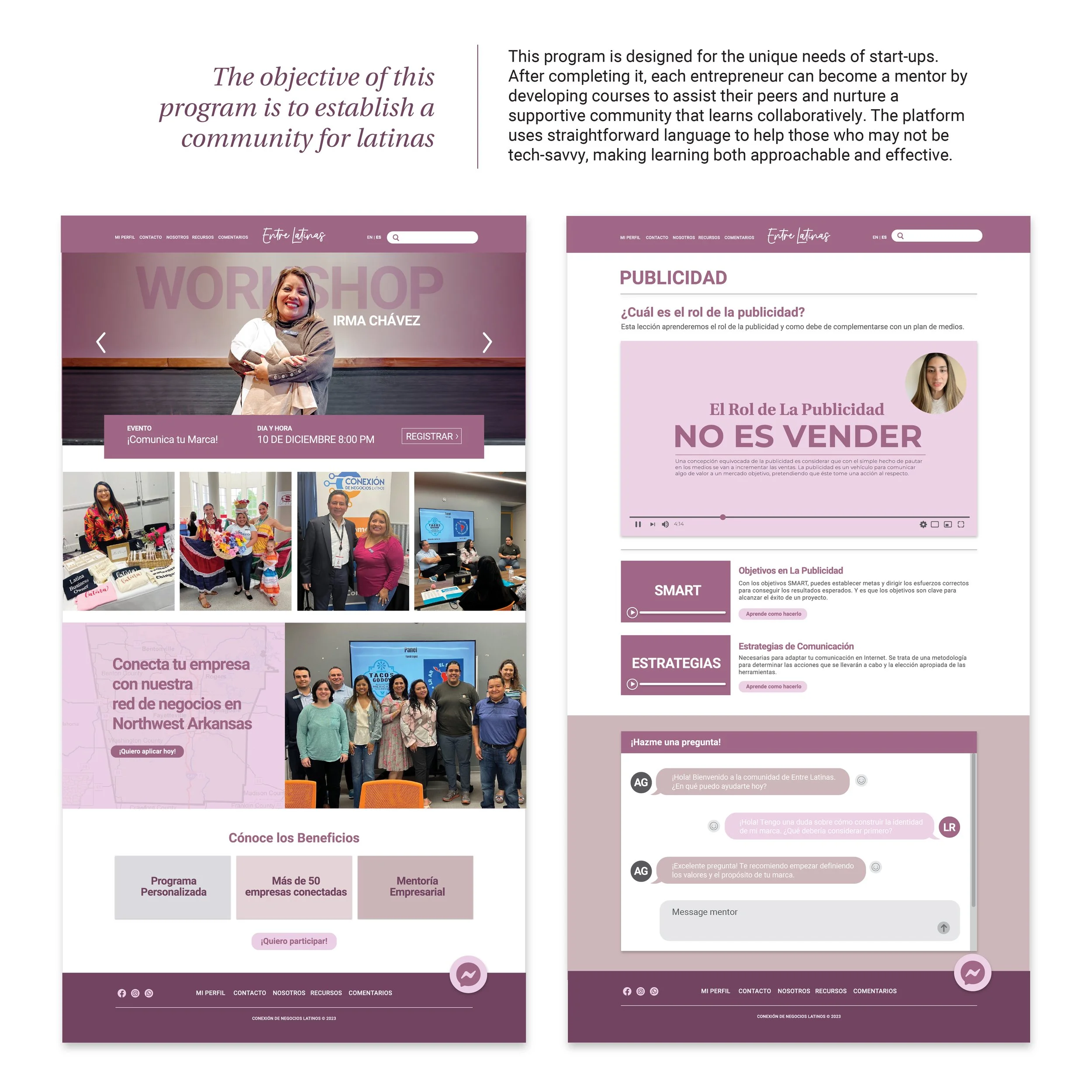
Each course is made up of short videos, accessible on any device, at any time. A built-in chat connects the learner directly with their assigned mentor while they work through the material. Questions don't have to wait until the next in-person meeting. Help is available inside the learning experience itself.
The diploma: proof of growth
When a learner completes a course, they receive a diploma certified by Conexión de Negocios Latinos. This detail came from a personal experience. When I worked in a corporate environment, completing a training program came with a certificate. That moment of recognition mattered. For entrepreneurs who have often been overlooked by formal systems, a diploma is proof of growth they can hold onto and share with their community.
And it unlocks the next step. Once a course is completed, that entrepreneur has the opportunity to become a mentor for the next cohort. The community teaches itself forward.

RESULTS:
The Entre Latinas platform successfully translated research insights into a functional, inclusive, and responsive digital learning experience.
Key outcomes include:
A bilingual, accessible learning environment tailored to Latina leaders
A mentorship-integrated digital system that fosters connection and confidence
A responsive design that works seamlessly across devices
A user-centered structure that reduces language and technology barriers
This project was not yet launched. But outcomes are not always numbers.
The research proved the gap was real. Three methods, two interviews, one community observation, and a content analysis all pointed to the same conclusion. The tools available to Latino entrepreneurs in Northwest Arkansas were not built for them.
Feedback shaped the final model. During the design process, my advisor identified that the platform needed a clearer cycle. The mentor transition, where graduates become teachers for the next cohort, was the missing piece that made the whole system sustainable. That one insight changed the architecture of the platform.
What this project would measure if launched
Course completion rates
Learner to mentor conversion
Community event attendance over time
Business growth among participants
The Latino population in Northwest Arkansas is forecasted to reach 19% by 2026. That growth deserves infrastructure. Entre Latinas is a proposal for what that infrastructure could look like, designed with the community, not just for them.
-
This project started as a research question and became something I genuinely believe in.
The part I am most proud of is the cycle. When a Latina entrepreneur completes a course, she doesn't just move on. She becomes a mentor for the next person. That model responds to my initial questions: Latinos are a source of innovation that is contributing to the local economy.
If I had more time, I would push the UI further. The structure and logic are solid, but the interface could use more movement and visual energy while staying simple and accessible. I would also go back to the research and interview entrepreneurs directly, not just leaders, to ensure every design decision makes sense for the people who would use the platform daily.
Next Steps
The dream is to partner with Conexión de Negocios Latinos and bring this to life.
To get there, the most important next steps are:
Build the mentor flow: The learner journey is designed. The mentor path needs the same attention. That is where the cycle becomes visible and real.
Pilot with real users: A small group of entrepreneurs from Conexión would be enough to test, learn, and iterate. Their feedback would shape the next version more than anything else.
Expand the content: Beyond marketing, finances, and design, the platform needs legal considerations. Understanding contracts, business registration, and immigration as it relates to business ownership are critical gaps for this community.
Pursue partnerships and funding: Grants, nonprofit partnerships, and university collaboration could make this sustainable beyond a prototype.
The Latino population in Northwest Arkansas is growing. The infrastructure to support that growth should grow with it.
Moving forward, I hope to continue designing with communities and creating work that meaningfully contributes to their growth and connection.